Monday, January 21, 2013
Jigsaw Puzzle
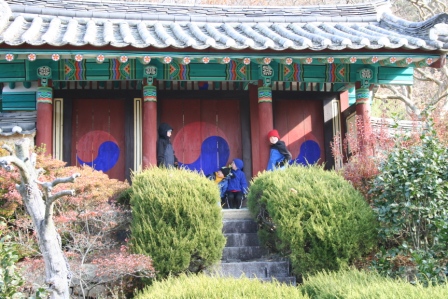
I took this picture on the grounds of Bulgaksa. It's a great puzzle picture with the nice reflection. It was a brisk fall morning, no wind. Too bad we missed the fall colors by a week or two. Still turned out nice, if I do say so myself.
Sunday, January 20, 2013
Bulguksa
| The main entrance leading into the temple. |
The entrance to the temple, Sokgyemun, has a double-sectioned staircase that leads to the inside of the temple compound. The stairway is 33 steps high, corresponding to the 33 steps to enlightenment. The stairs are original (750), so they have been around for quite awhile. The staircase is actually called a bridge, as there is an archway underneath. The stairs pictured here are Blue Cloud and White Cloud Bridges.
| Dabotap |
There are two pagodas on the temple site. The three-story Seokgatap Pagoda which stands at 8.2 meters is a traditional Korean-style stone pagoda with simple lines and minimal detailing. It is the male pagoda. Seokgatap is over 13 centuries old and was under restoration during our visit (they found a crack in a foundation stone during a routine inspection). Dabotap is 2 meters taller than Seokgatap. It is the female pagoda; known for its highly ornate structure.
| Huge bell at the temple. Wish I had a picture of the plaque to tell you about it. |
There are many bronze Buddha statues on the premises. They are in the different temple halls, but it is forbidden to take pictures of them or the insides of the temple halls.
| Near the temple entrance. |
| Detail work. Crazy! |
Squid
Koreans love squid. We have seen fried squid, dried squid, on a stick squid. During our trip to the coast we were able to catch the vendors drying their squid. Once they catch the squid the slice it open, spread it flat, and clean it up. Then they are hung from lines right on the beach (like the photo above). They hang there to dry before they are bundled up and shipped to the various cities. You can even attend a squid festival in the fall (which appears to be the squid drying season) Look at all that squid!
Squid dries in the sun
Koreans eat them yum yum
At the fish market.
J1
Squids are awesome
Squids are super fast
Squids are super cool
They are everywhere.
J4
Squid dries in the sun
Koreans eat them yum yum
At the fish market.
J1
Squids are awesome
Squids are super fast
Squids are super cool
They are everywhere.
J4
Saturday, January 19, 2013
Tombs and Burial Mounds
There are burial mounds all over South Korea. They are tourist spots, some where you pay an entrance fee. Others are on the hillsides along the roads and quiet valleys. We saw many on our drive south. They are everywhere. Here is a sampling of what we have seen.
We visited the Underwater burial mound of King Munmu. King Munmu (600s BC) unified the three kingdoms and became the 30th ruler of the Silla Kingdom. The
king gave specific instructions to be buried in the East Sea after his death so
that he would become a dragon and protect Silla from Japanese intruders. The
rocky island has a pool at the center. The bottom of the pool is a granite slab. Legend has it that the
remains of King Munmu’s cremated body are buried under this rock. Others say the ashes were scattered at sea rather than placed under the granite. I guess we will never know! Korean's flock to this burial location.
| A rare square royal burial mound. |
| Smaller royal burial mounds. |
| Larger royal burial mounds, these are as tall as the trees. |
| Underwataer tomb. Pretty impressive. |
Sunrise Square
Around the Peninsula from Pohong is Sunrise Square in Homigot. It is the eastern most part of South Korea. There is a lighthouse and museum, tourist gift shop, restaurants, and lots of fish.
From Korean Tourist Organization: The Homigot Lighthouse was built using bricks in a modern architectural style.
This octagonal, six-story building is 26.4 meters high. The entrance and windows
feature gable decorations, which is a popular Greek Revival style. The ceiling
is dome-shaped and the octagonal plane gets wider towards the bottom. The light
of the lighthouse can reach as far as 35 kilometers away.
Because the building was built using bricks only and no reinforcing rods, it is recognized for its use of outstanding architectural technique. The ceiling on each floor is sculpted in the shape of pear blossoms, a symbol of the Joseon royalty. This adds to the lighthouse’s considerable value as a cultural asset.
| Sunrise Square |
We saw the Hands of Harmony, a massive bronze sculpture of a hand stretching up from the water in a small cove. There is a matching hand of equal proportion stretches up from dry land on the other side of Homigot Sunrise Square.
The hand in the water is the attraction, particularly at sunrise. This particular cove's claim to fame is that it is the farthest point east in Korea (also referred to as the Tiger's Tail) so the sun rises here first on the Land of the Morning Calm.
| Here the boys are with the Hand of Harmony. |
| Pohong Lighthouse |
Because the building was built using bricks only and no reinforcing rods, it is recognized for its use of outstanding architectural technique. The ceiling on each floor is sculpted in the shape of pear blossoms, a symbol of the Joseon royalty. This adds to the lighthouse’s considerable value as a cultural asset.
| Frying up some squid on the beach. A tasty treat. |
| View from the pier. |
| Fish. Fish. Fish. |
| The view from the Sunrise tower. |
Thursday, January 17, 2013
Songdo Beach (송도해수욕장)
Part of our trip took us to Pohong. The city is on the eastern side of South Korea, located on the coast. It is home to POSCO, one of the world's largest steel companies, which sits prominently on the bay. The beach we visited, Songdo, was next door to POSCO. We hoped to take a tour, but foreigners require a week advance reservation.
Songdo beach is a great little beach, which is apparently extremely popular in the summer. It was a ghost town the day we visited. It has a wide boulevard running behind the sea wall. There are many restaurants lining the street. They were almost all closed for the season.
| Jakob with the bay behind. |
| James walking along the breakers at the beach. |
| The shell collection on the jetty. |
| There is POSCO behind James. |
Tuesday, January 15, 2013
Korean Folk Village - Yangdong
Okay, there are a lot of these folk villages around. You could tour endlessly, seriously. Some are museum-ish, like the Andong Folk Village. Nothing is happening. No one lives there, the houses were brought to the site to create a village. It is a visual of Korean housing during the 1800's.
Then there are others like, 경주 양동마을 (Gyeongju Yangdong Village), which is a living, breathing, working village. The village is inhabited by Koreans, many of the same family line (lee and Son), to this day. Some of the houses have been restored. Others are just the way they have been for centuries. The families still come together for celebrations and festivals.
Gyeongju Yangdong Village is situated on Mt. Soelchang and in the four valleys it creates, which is in the shape of 勿, which is something significant, but I am drawing a total blank right now!
The village is the biggest village composed of two main families from the Chosun Dynasty. The hundreds years old tile-roofed houses (upper class), thatched roof houses (lower class), and low stone walls make it a lovely place to visit. It is on the UNESCO world heritage sites list. I would say our best village visit yet.
Then there are others like, 경주 양동마을 (Gyeongju Yangdong Village), which is a living, breathing, working village. The village is inhabited by Koreans, many of the same family line (lee and Son), to this day. Some of the houses have been restored. Others are just the way they have been for centuries. The families still come together for celebrations and festivals.
Gyeongju Yangdong Village is situated on Mt. Soelchang and in the four valleys it creates, which is in the shape of 勿, which is something significant, but I am drawing a total blank right now!
The village is the biggest village composed of two main families from the Chosun Dynasty. The hundreds years old tile-roofed houses (upper class), thatched roof houses (lower class), and low stone walls make it a lovely place to visit. It is on the UNESCO world heritage sites list. I would say our best village visit yet.
| Roof thatch made of rice straw. |
| Thatching in progress. |
| Some of the fall color. |
| A door near Seobaekdong, one of the original family homes, where they were holding prayer. |
I took a picture of the sign in the visitors center regarding this tree (I need to do this more often, as it is usually the best source of information). The sign said the juniper tree is 7m tall, but 12 meters wide. It is estimated to be over 600 years old; planted when the village founder Son So built the family home, Seobaekdong, in 1459.
| Under the tree. There are many supports for the branches. |
| Looking across one of the four valleys of the village. |
Subscribe to:
Posts (Atom)